
Situational Leadership
There is no single leadership style that works for everyone in every situation. A new hire full of energy and an experienced engineer who lost motivation require very different approaches from their leader.
Situational leadership is the ability to adapt your leadership style to the context you find, which involves three skills:
- Diagnosis: Assessing the development level of the person for a given task or goal;
- Flexibility: Being comfortable using different leadership styles;
- Matching: Applying the leadership style that fits the situation.
The Four Development Levels
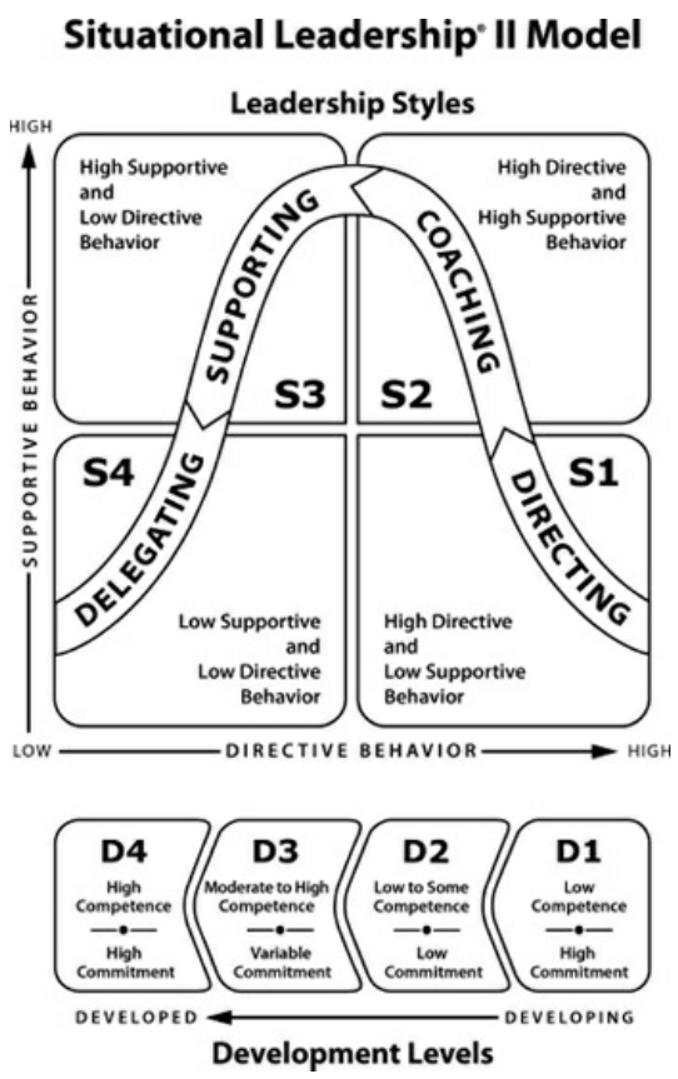
The Situational Leadership II model, by Ken Blanchard, describes development as a combination of two factors: competence and commitment.
Competence is a function of knowledge and skills, which can be gained from learning and experience. Commitment is a combination of confidence (the ability to perform a task well without much supervision) and motivation (the interest and enthusiasm to do it well).
When someone doesn’t perform well without direction, it may be a problem of competence, commitment, or both. The combinations of these two factors form four development levels:
- D1 — Enthusiastic beginner: Low competence, high commitment;
- D2 — Disillusioned learner: Low to some competence, low commitment;
- D3 — Capable but cautious performer: Moderate to high competence, variable commitment;
- D4 — Self-reliant achiever: High competence, high commitment.
The Four Leadership Styles
To match the four development levels, the model describes four leadership styles, characterized by different degrees of directive and supportive behavior:
- S1 — Directing: Indicated for enthusiastic beginners (D1). They are motivated, but need direction and frequent feedback to build their skills. This style also fits situations where a quick decision must be made and the stakes are high;
- S2 — Coaching: Indicated for disillusioned learners (D2). They still need direction and feedback due to their limited experience, but they also need support and recognition to build confidence, and involvement in decision-making to restore commitment;
- S3 — Supporting: Indicated for capable but cautious performers (D3). They don’t need much direction because they already have the skills, but they need support to reinforce confidence and motivation;
- S4 — Delegating: Indicated for self-reliant achievers (D4). They are high performers, willing to work on their own with little direction and support. This is where delegation shines.
Matching Style and Situation
The key insight of the model is that development levels are task-specific, not people-specific. The same person can be a self-reliant achiever (D4) in one activity and an enthusiastic beginner (D1) in another. A senior engineer joining your team may have great technical skills, but may not know the priorities, policies, or processes of the company yet, and will benefit from some direction at first.
As a leader, your job is to diagnose the development level for the task at hand and provide the corresponding balance of direction and support. Over-supervising a high performer is as harmful as abandoning a beginner.